
FIREFOXES
← Back to the Firefoxes

RESEARCH · DISCOVERY · IDEAS

Our Innovation Project

Spotted lanternflies: understand the insect, investigate the problem, and explore a solution.

THE FIREFOXES INNOVATION PROJECT

Small insect. A focused solution.

Our research, main question, and proposed idea · Solution in development

The spotted lanternfly, Lycorma delicatula, is a sap-feeding insect called a planthopper. Originally from Asia, it was first detected in the United States in Pennsylvania in 2014. It is considered invasive here because it has spread outside its native range and can cause harm. Although its spotted wings are beautiful, its effects on grapevines and outdoor spaces make it an important problem to investigate. Our team, the Firefoxes, wants to understand this insect before designing a useful way to control it. [1]

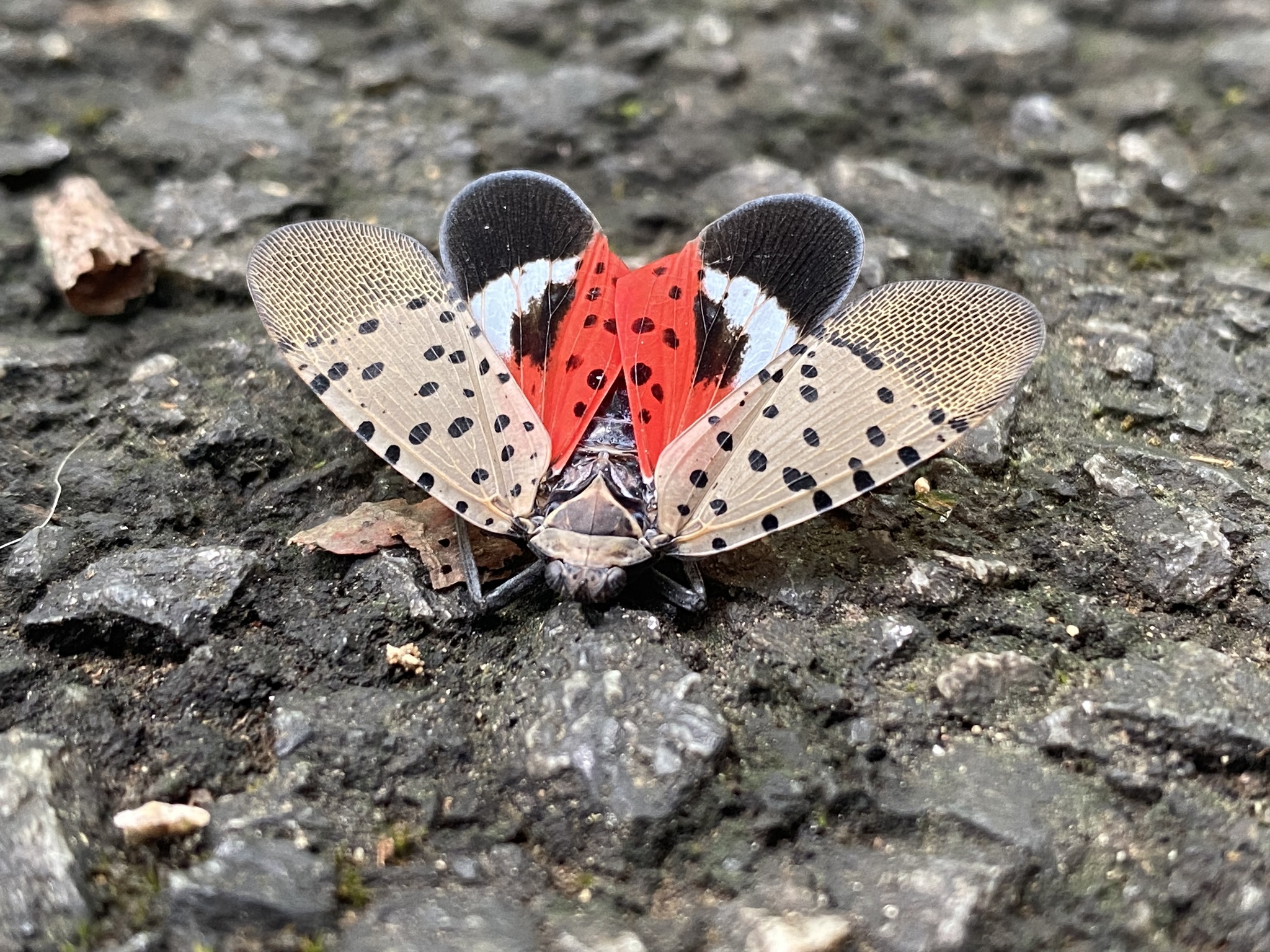
Spotted lanternflies grow through an egg stage, four young stages called nymph stages, and adulthood. Early nymphs are black with white spots; the final nymph stage includes red. Adults have spotted forewings and red patches on their hindwings. In our region, they have one generation each year and survive winter as eggs. Egg masses can be attached to trees, rocks, outdoor furniture, and vehicles. When people move these objects, they can accidentally carry eggs to new places. Nymphs jump, while adults can also fly, making capture a design challenge. [2]

Lanternflies use piercing mouthparts to feed on plant sap. Heavy feeding can weaken grapevines, reduce harvests, and sometimes contribute to vine death. However, seeing lanternflies on a tree does not mean the tree will die. Cornell reports that serious agricultural concern is especially focused on grapes. Lanternflies also release sugary waste called honeydew. It can cover leaves, furniture, and other surfaces, encouraging dark sooty mold. They do not bite or sting people, but large numbers and sticky waste can make outdoor spaces unpleasant. [3]

Our main question is: How can we quickly capture and kill spotted lanternflies while protecting other insects, animals, and trees? Speed matters to us, but accuracy matters too. A device that collects many insects would not be successful if it also catches the wrong species or damages bark. Our goal is a targeted tool that people can aim carefully, rather than a device that acts on every moving insect.

Our proposed direction is a small rover with a collection attachment, potentially made with 3D-printed parts. One possible first version would let a person identify a lanternfly, steer the rover, and activate the collector. This could make the coding simpler while we learn how the mechanism behaves. We are still deciding how collection would work and what method could kill captured lanternflies safely and reliably. Instant killing is a goal to investigate, not a result we have achieved. Our LEGO Robot Game build is separate from this proposed innovation prototype.

We plan to begin with pretend insects on a model surface. We can measure collection time, successful captures, missed targets, accidental collection of other pretend species, and surface contact. Then we can compare designs, change one feature, and repeat the same tests. We also want feedback from an insect expert and people affected by lanternflies before considering real-world trials. Our project is still developing: we will share what works, what fails, and what evidence supports each improvement.
GET TO KNOW THE INSECT

Lanternfly facts, explained simply.

01

A sap-drinking insect

A spotted lanternfly is a planthopper. Its mouthpart pierces a plant so it can drink sap. It does not chew leaves like a caterpillar.

02

One generation each year

Eggs survive the winter. Young insects, called nymphs, hatch in spring. They grow through four nymph stages before becoming adults.

03

The colors change

Early nymphs are black with white spots. The last nymph stage adds red. Adults have spotted forewings and striking red patches on their hindwings.

04

Eggs can hide in plain sight

An egg mass usually holds 30–50 eggs, often under a waxy covering. Eggs can be laid on tree trunks, stones, metal, and other hard outdoor surfaces.

05

They can hitchhike

Egg masses and insects can travel on vehicles or outdoor objects. Moving an item can accidentally move lanternflies to a new place.

06

A sticky problem

Lanternflies release sugary waste called honeydew. It can coat outdoor surfaces and encourage dark sooty mold to grow.

07

Plants and people are affected

Feeding can harm grapevines. Honeydew and mold can make backyards unpleasant and affect crop quality. Not every tree with lanternflies will die.

08

Movement matters to our design

Nymphs and adults can jump; adults can also fly. A capture idea needs to account for insects moving away before they are caught.

Sources: Cornell IPM biology and damage guides, and Cornell Cooperative Extension. Links below.

OUR INNOVATION PROJECT

Meet the spotted lanternfly.

An insect worth understanding.
A problem worth investigating.

FIELD NOTES / 01LOOK CLOSER
Close-up photograph of an adult spotted lanternfly with its red hindwings spread
Spotted lanternflyLycorma delicatulaPhoto: gwtstl / iNaturalist · CC BY 4.0
SMALL INSECT. BIG QUESTIONS.

Our spotted lanternfly investigation

Our Innovation Project is one part of our FLL journey. We are exploring how people can find and capture spotted lanternflies while protecting other insects.

Explore our research sources ↗

What is the problem?

The spotted lanternfly is an invasive insect that feeds on plant sap. It can harm grapevines and leaves behind sticky waste called honeydew. Large numbers can also be a nuisance in outdoor spaces.

Finding a lanternfly on a tree does not mean that tree will die. We want our project to share accurate information.

Learn from Cornell IPM ↗
OUR RESEARCH QUESTION

How can we quickly capture and kill spotted lanternflies while protecting other insects, animals, and trees?

This is a starting question for our project. Our final solution and test results will be added as our work develops.

OUR DISCOVERY JOURNEY

Better questions help us build better ideas.

Finding is part of the problem.

We asked about eggs high in trees. That led us to think about where a capture device could actually reach.

Protecting other insects matters.

We want to explore ways to catch lanternflies while avoiding other insects.

An idea needs evidence.

We are still comparing approaches. A drawing or prototype is a starting point; testing will show what needs to improve.

SOLUTION IN DEVELOPMENT

From a question to an idea.

Our proposed direction is a small rover with a targeted collection attachment, potentially using 3D-printed parts. Human-controlled operation is one possible starting point. We have not finalized the collection or killing mechanism, built a validated solution, or demonstrated instant killing. We plan to test with pretend insects first, compare speed and accuracy, and ask for expert feedback. Our Robot Game robot is a separate build.

OUR PROCESS

Follow our learning journey.

Our learning roadmap.
Completed work will be added here.

  1. 01

    Research

    Learn about the insect's life cycle, spread, and impact. Keep a list of reliable sources.

  2. 02

    Ask & listen

    Ask an insect expert or community member what makes this problem difficult.

  3. 03

    Design & build

    Compare ideas, choose one, and make a drawing or simple prototype.

  4. 04

    Test & improve

    Record what works, what does not, and what we change after feedback.

  5. 05

    Share

    Explain our findings and solution with our school and through this website.

These are planned steps, not a record of completed experiments.

OUR RESEARCH SHELF

Where the facts come from.

These references support the information on this page. Our own experiment results and expert interview notes will be added when available.

Encyclopedia overview

More background and references for further reading. Our science summary is supported by university extension sources.

Explore Wikipedia ↗